New-home investment rises as knock-down rebuild spending falls 32%
KPMG says housing investment is shifting away from replacing one home with another and towards projects that add dwellings, although Australians still spent $56.2 billion renovating in 2025-26.

RentBuy Team
4 min read
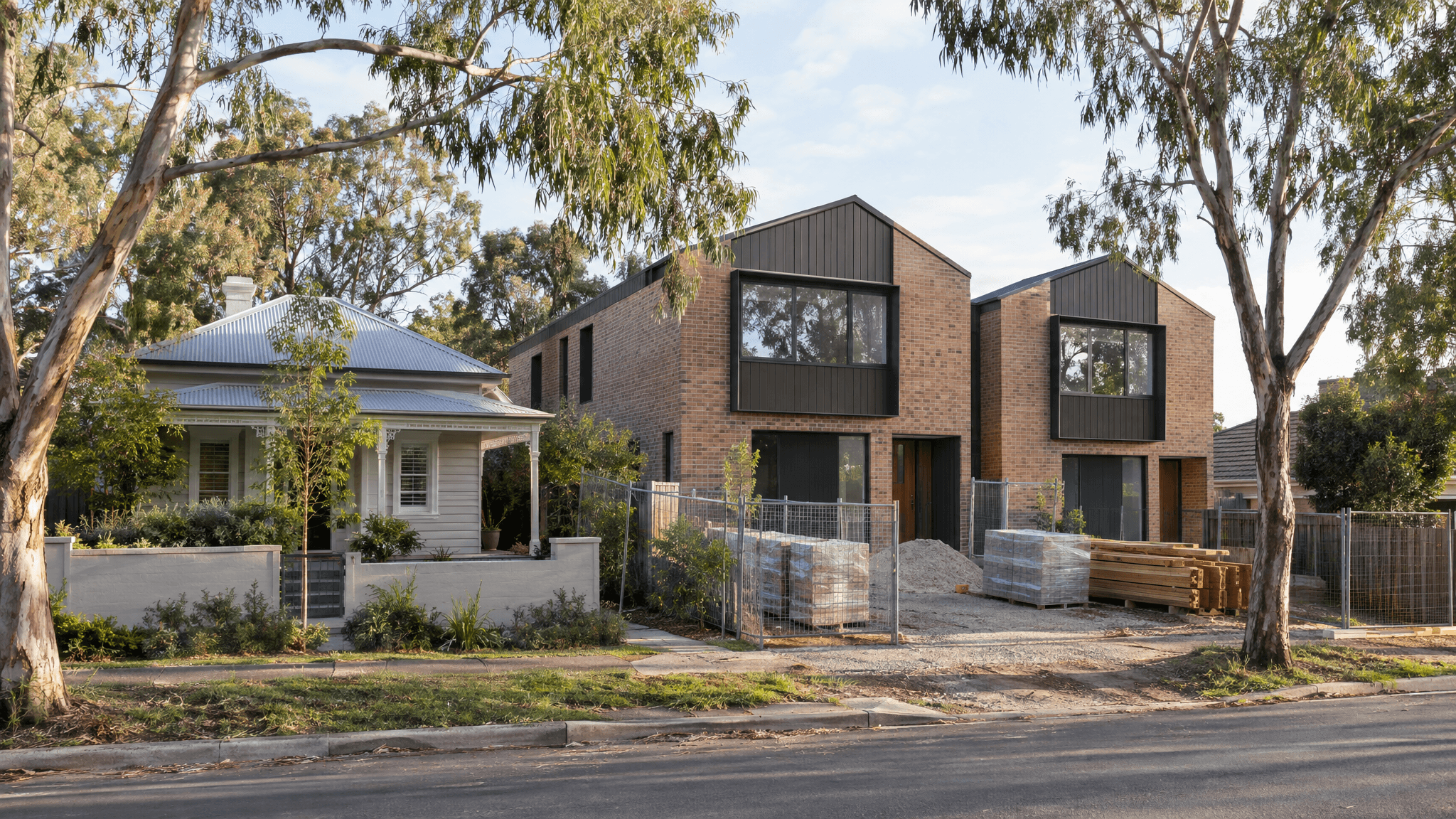
Australian housing investment is shifting towards projects that increase the number of homes, with spending on new dwellings rising while one-for-one knock-down rebuild activity declines.
KPMG Australia reported on Monday that investment in new builds had increased 20 per cent over four years. Spending on projects where an existing home was demolished and replaced with a single new dwelling fell 32 per cent over the same period.
The consultancy said the change suggested planning reforms and market conditions were making it more practical to add homes to established sites, including through duplexes and other forms of medium-density development.
That is an important distinction for housing supply. Replacing an old detached house with a new detached house may improve the quality and efficiency of the property, but it does not increase the number of homes available. A redevelopment that delivers two or more dwellings can.
KPMG urban economist Terry Rawnsley said reduced spending on one-for-one replacement projects, combined with stronger new-home investment, was evidence that the gradual densification of established suburbs was beginning to have an effect.
The investment figures should not be read as a direct count of completed homes. They measure the value of residential construction activity, and higher labour and material costs can lift spending without producing a matching increase in dwelling numbers. Even so, the changing balance between additional homes, replacement projects and renovations provides a useful indication of where household and developer money is going.
Renovation spending remains elevated
Australians have not abandoned renovation projects. KPMG said alterations and additions spending rose by almost 5 per cent over the latest year to $56.2 billion.
Renovations represented 37 per cent of housing spending in 2025-26. That was below the pandemic-era peak, when working from home and rapidly changing household needs helped lift the share to 40 per cent in 2021-22, but it remained well above the 33 per cent recorded in 2019-20.
The continuing strength of renovations reflects several pressures. Moving can involve stamp duty, selling costs and a larger mortgage, while established properties in tightly held suburbs may be difficult to replace. Heritage controls, limited vacant land and the value of an existing location can also make an extension or substantial upgrade the more practical choice.
Different patterns across the states
In New South Wales, spending on new dwellings once again exceeded renovation spending during 2025-26. KPMG said $2.1 billion of renovation activity was concentrated in inner suburban heritage areas and popular coastal locations, representing 48 per cent of the state’s renovation spending.
The Northern Beaches, Sutherland Shire, City of Sydney and Inner West were among the areas highlighted, while Wollongong was the only regional council in the state’s top 10 renovation markets.
Victoria recorded $24.4 billion of investment in new dwellings, its highest level since before the pandemic. Renovations accounted for $13 billion and one-for-one replacement projects for another $4.2 billion.
KPMG attributed Victoria’s comparatively higher level of replacement housing partly to Melbourne’s larger suburban blocks and more limited opportunities for townhouse or apartment development in some established neighbourhoods.
Queensland recorded $17.9 billion of new-build investment in 2025-26, compared with $13 billion for renovations. Brisbane accounted for almost $1.5 billion of renovation approvals, while renovations represented 32 per cent of residential building activity in Noosa.
Western Australia remained the most heavily tilted towards additional new housing. It recorded $8.2 billion in new-dwelling investment, against $5 billion in renovations and $556 million in one-for-one replacements. New residential construction spending in the state increased 11.4 per cent during 2025-26.
What it means for you
- Buyers should check whether a property’s zoning and lot dimensions allow a second dwelling, rather than assuming redevelopment potential.
- Owners considering a knock-down rebuild should compare the cost and approval pathway with a duplex, secondary dwelling or renovation.
- Sellers with development-capable land may attract a different buyer pool, but should obtain planning advice before marketing it as a multi-home site.
- Strong spending figures do not guarantee faster completions, so buyers of new homes should still examine builder capacity and contract time frames.