
Falling home prices and rising building costs squeeze Australia’s housing pipeline
Morgan Stanley expects a 10% to 15% peak-to-trough fall in home prices, while Cotality says construction costs are accelerating again. Together, the trends could make new projects harder to finance and deliver.

RentBuy Team
4 min read
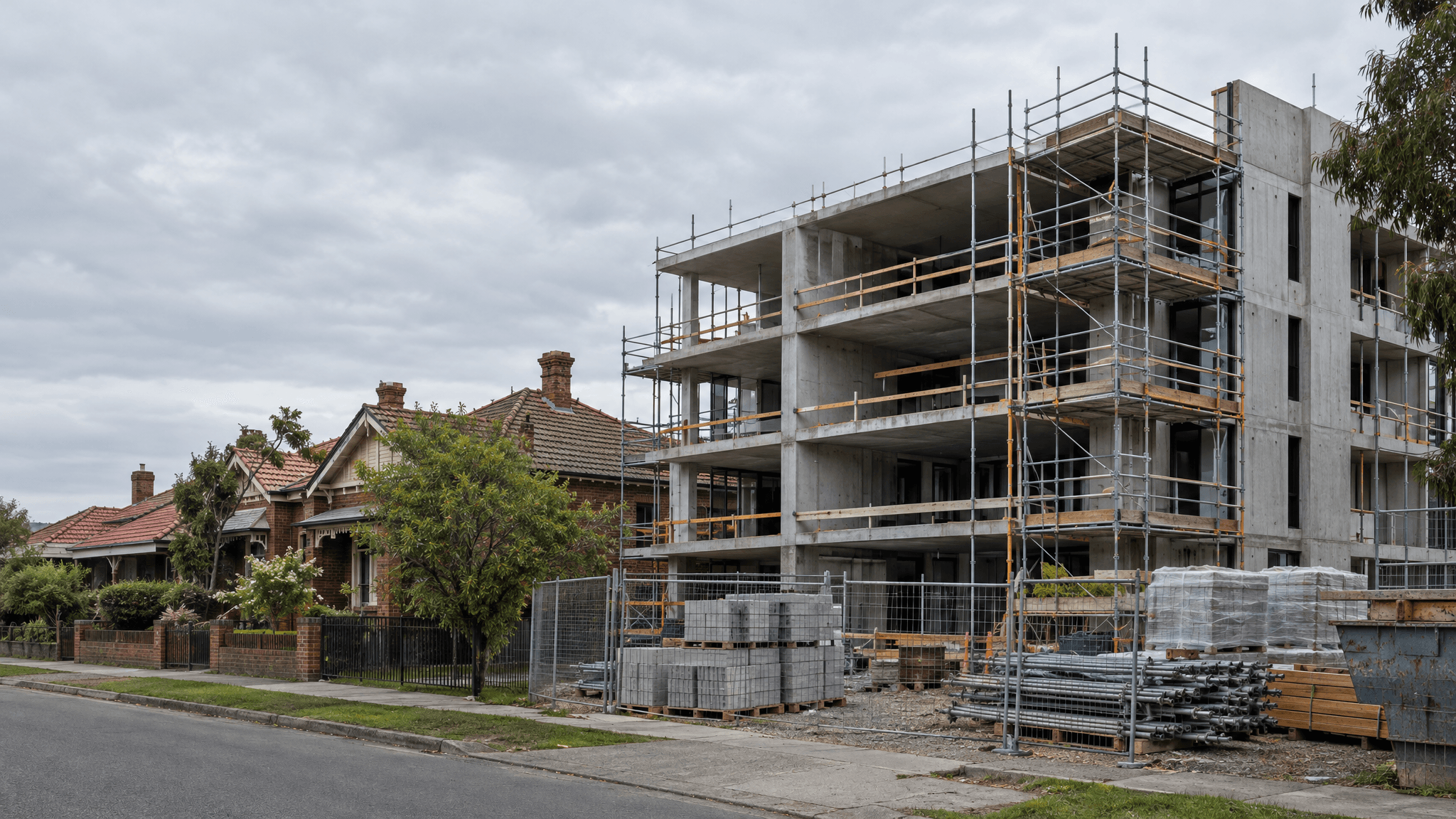
Australia’s housing downturn could become deeper and longer just as the cost of building new homes begins to accelerate again, creating a difficult equation for developers, buyers and the national housing supply target.
Morgan Stanley now expects national home prices to fall between 10 per cent and 15 per cent from their peak, according to an Australian Associated Press report published on Wednesday. The investment bank expects the market to reach its low point in the second half of 2027.
Cotality data cited in the report shows dwelling values have already fallen 5.2 per cent since peaking in March 2026. If Morgan Stanley’s forecast proves accurate, the national market may therefore be only part-way through its adjustment.
The investment bank described the projected fall as potentially Australia’s largest nominal housing downturn in more than 40 years. Its forecast is not a certainty, however: interest rates remain the main variable, while housing results will differ substantially between cities, suburbs and property types.
Morgan Stanley identified several signs that could indicate the market is approaching a floor. These include financial markets beginning to expect interest rate cuts, auction clearance rates improving, sales rising relative to listings and the cost of owning moving closer to the cost of renting.
It does not expect those conditions to turn decisively before the middle of 2027.
The cost of creating new supply is rising
Lower established-home prices would normally help buyers, but they also reduce the prices developers can expect to receive for new dwellings. That becomes a bigger problem when construction expenses are still climbing.
Cotality’s Cordell Construction Cost Index, released on Wednesday, recorded a 1 per cent national increase in residential construction costs over the September quarter. Annual cost growth accelerated from 2.8 per cent in June to 3.2 per cent in September.
The quarterly increase was well above the subdued 0.2 per cent recorded at the beginning of 2026, although Cotality said cost escalation remained below the unusually high rates seen after the pandemic.
Western Australia recorded the strongest quarterly increase at 1.1 per cent. Costs rose 1 per cent in New South Wales and Queensland, while Victoria and South Australia recorded increases of 0.9 per cent.
Cotality said plastics increased across the board during the quarter, with smaller rises in plasterboard. It also warned that international disruption could continue to flow through to material prices and already-tight builder margins.
For households planning a new build or major renovation, the figures are a reminder that a cooling property market does not necessarily mean a cheaper construction contract. Land prices, labour, materials, site conditions, finance and builder risk all contribute to the final budget.
Project feasibility is the pressure point
A developer generally needs expected sales revenue to cover land, construction, finance, planning, marketing and other costs while leaving an acceptable margin. Falling selling prices and rising building expenses squeeze that calculation from both sides.
That can lead to projects being delayed, redesigned or abandoned, even when they already have planning approval. Apartment projects are especially sensitive because developers often need enough pre-sales to secure construction finance.
The AAP report said 355,817 dwellings were completed in the first two years of the national goal to build 1.2 million homes over five years, leaving delivery about 124,000 homes behind the required pace.
A prolonged feasibility squeeze could widen that gap. It may also create a delayed supply problem: fewer projects beginning now means fewer completed homes available to buyers and renters in several years.
For existing homeowners, a national forecast should not be treated as a valuation of an individual property. Local supply, buyer budgets, dwelling quality and the reason for selling will shape each result. Owners who do not need to transact may experience the downturn mainly as a lower paper value, while recent highly leveraged buyers face greater refinancing and negative-equity risks.
What it means for you
- Buyers may gain negotiating power, but should base offers on comparable sales and repayments rather than trying to predict the exact bottom.
- New-home buyers should keep a contingency for variations, site costs and delays because construction costs are still increasing.
- Sellers and developers may need more realistic pricing as borrowing capacity and buyer confidence remain constrained.
- Renters could face longer-term supply pressure if today’s project delays reduce the number of homes completed in coming years.