Student housing pipeline grows, but delivery dates leave rental relief uncertain
New analysis counts almost 108,000 operational student beds across six cities and a sizeable development pipeline. Much of that supply has no confirmed opening date, limiting immediate relief for private renters.

RentBuy Team
4 min read
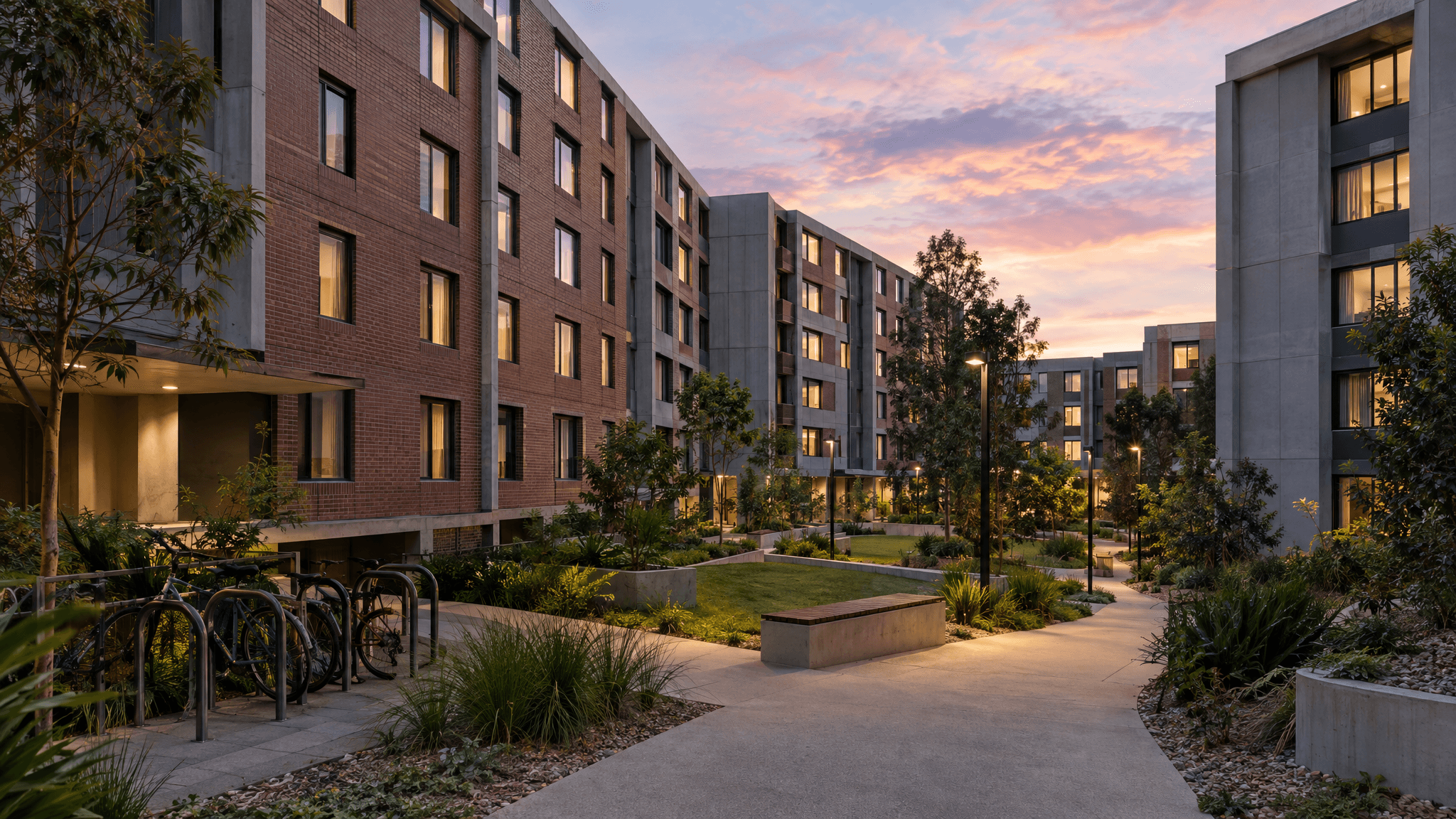
Australia has almost 108,000 purpose-built student accommodation beds across six major university cities, with a further substantial pipeline planned or under construction, according to analysis published on Friday.
Student housing research company BONARD counted 442 operating residences providing 107,823 beds across the cities it monitors. Private operators control 71 per cent of that stock, while four providers account for almost three-quarters of privately operated beds.
The report identified about 38,000 pipeline beds across 69 proposed or developing residences. Approximately 10,000 are scheduled to open during 2026 and 2027, but almost 20,000 have no publicly disclosed opening date.
That distinction is crucial for renters. A proposed bed does not ease competition until a project is financed, built and ready for occupation.
Supply is not arriving evenly
Brisbane leads the number of beds expected to open during 2026 and 2027, according to BONARD, while Melbourne and Perth account for much of the supply scheduled from 2028 onwards. Sydney is expected to add 1,433 beds over the next two years.
Adelaide’s prospective pipeline is large relative to its existing student accommodation stock, although many opening dates remain undisclosed. Perth also has a substantial pipeline compared with its current base.
The results broadly support earlier industry research. The Property Council’s Student Accommodation Council and Urbis counted 47,233 beds in Australia’s nationwide planning, approval and construction pipeline in June, including more than 14,100 already under construction.
The totals are not directly interchangeable because the reports use different geographic coverage and methodologies. BONARD’s operational and pipeline analysis covers six monitored cities, while the Property Council figure is a broader national pipeline estimate.
Both point to the same practical issue: the headline pipeline is much larger than the amount of accommodation certain to open in the near term.
University demand is changing rather than disappearing
Australian Government data show 687,810 international students studied in Australia in the first six months of 2026, down 7 per cent from the same period in 2025. Commencements fell 9 per cent and total enrolments were down 8 per cent.
The decline was concentrated outside universities. Higher education enrolments increased by 2 per cent, while enrolments in English-language intensive courses fell 27 per cent.
That split matters for housing demand because university students are more likely to study for several years and seek accommodation in major metropolitan education precincts.
The federal government has kept the national planning level for new overseas student commencements at 295,000 for 2027, unchanged from 2026. Public universities seeking additional international growth have also been asked to demonstrate progress on student accommodation.
Stable commencement settings give developers a clearer demand outlook, but they do not remove the obstacles affecting residential construction generally. High building costs, financing conditions, planning timeframes and uncertain completion dates can all delay projects.
What it could mean for private rentals
Purpose-built residences can reduce the number of students competing for conventional share houses, studios and inner-city apartments. The effect is likely to be strongest around campuses and transport corridors where student demand is concentrated.
However, student accommodation is not a substitute for general rental supply. It is designed for a specific population, commonly uses individual rooms with shared facilities and may have rental structures that differ from ordinary apartments.
A new residence may free some private rentals as students move into dedicated accommodation, but the size of that effect depends on location, price and whether the beds attract students who would otherwise have rented existing homes.
For now, renters should treat the scheduled 2026 and 2027 openings as the most relevant part of the pipeline. Projects without confirmed dates may improve supply later, but they offer little immediate help in a tight local market.
What it means for you
- Renters near major campuses should watch confirmed opening dates rather than total pipeline announcements.
- Students should compare the full weekly cost, contract length and included services with private share housing.
- Apartment investors may face more competition from dedicated accommodation in precincts receiving large numbers of new beds.
- Additional student rooms can help local rental markets, but they cannot replace broad construction of ordinary homes.