Apartment approvals plunge as new-build costs rise 5.4%
Approvals for apartments and other attached homes fell 21.2% in August, while detached-house approvals rose. At the same time, new dwelling costs remained well above general inflation.

RentBuy Team
4 min read
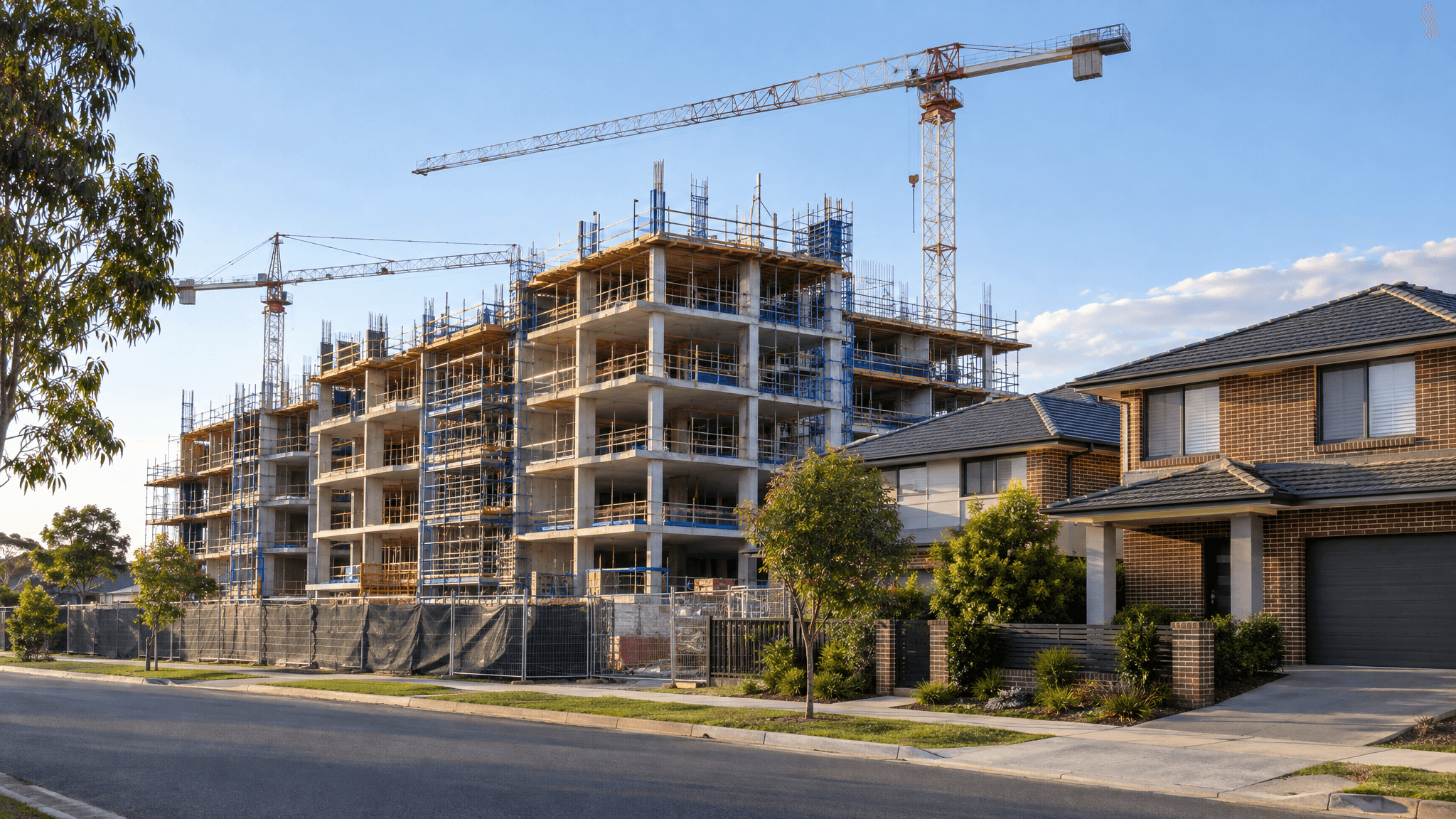
Australia’s housing pipeline weakened in August as approvals for apartments, townhouses and other attached dwellings dropped sharply, highlighting the difficulty of expanding supply while construction and finance costs remain elevated.
Australian Bureau of Statistics figures released on Wednesday show total dwelling approvals fell 6.1 per cent in seasonally adjusted terms to 16,953. It was the second consecutive monthly decline, although approvals remained 10.3 per cent higher than a year earlier.
The headline fall concealed a widening divide between detached houses and higher-density housing.
Private detached-house approvals rose 3.7 per cent to 10,885, their highest level since August 2021, according to Westpac Economics. Approvals for private dwellings excluding houses fell 21.2 per cent to 5,674.
That second category includes apartments, townhouses and semi-detached homes — the types of development governments increasingly need around transport, employment and established services.
A volatile apartment pipeline
Monthly apartment approvals can move dramatically when one or two large projects enter or leave the figures. The August decline therefore does not mean one-fifth of the country’s long-term apartment pipeline disappeared in a single month.
However, the fall matters because it follows years of difficulty turning proposed apartment developments into viable projects. Developers must cover land, materials, labour, finance and regulatory costs before construction begins, while also being confident buyers will pay enough for the completed homes.
The latest inflation data illustrates that pressure. The ABS said housing costs rose 5.7 per cent over the year to August and were the largest contributor to annual inflation.
Prices for new dwellings purchased by owner-occupiers increased 5.4 per cent over the year as builders passed on higher labour and material costs. This CPI measure relates to the construction component of a new home and excludes the value of the land.
Rents rose by a slower 3.6 per cent over the year and 0.3 per cent in August, according to Westpac’s analysis of the CPI release.
The value of residential building work approved also fell 0.6 per cent in August to $11.3 billion.
States move in different directions
The national result was pulled down by large monthly falls in Queensland and New South Wales. Total approvals decreased 22.5 per cent in Queensland and 17.3 per cent in NSW, while Tasmania recorded a 1.5 per cent decline.
South Australia led the states recording increases, up 24 per cent, followed by Victoria at 8.9 per cent and Western Australia at 3.2 per cent.
These monthly movements should be treated cautiously, particularly where apartment projects create large swings. Even so, the NSW and Queensland falls are significant because both states need substantial additions to their housing stock and contain some of Australia’s most pressured rental markets.
In trend terms, which smooths some monthly volatility, total approvals declined 0.8 per cent to 18,202. That measure suggests the underlying pipeline remains stronger than the seasonally adjusted headline but has started losing momentum.
Approvals are only the first step
The National Housing Accord aims to deliver 1.2 million well-located homes during the five years to June 2029. That is an average of 20,000 completed dwellings each month.
Approvals are not completions. Some approved developments are redesigned, delayed or abandoned, while others can take years to finish. Australia therefore needs approvals to remain comfortably above the required completion rate for an extended period if the target is to be met.
The August result is not uniformly weak. Detached-house approvals are holding up and are substantially higher than a year ago. That may support builders specialising in new estates and individual homes.
The concern is the attached-housing pipeline. Apartments and townhouses can add many homes on relatively small sites, but they are also more exposed to lengthy planning processes, presales requirements, complex construction and financing costs.
Higher interest rates add pressure on both sides of these projects. Developers face more expensive funding, while buyers have less borrowing capacity. Falling established-home prices can make the equation harder again if buyers can purchase an existing dwelling for less than the price required to make a new project viable.
What it means for you
- Buyers considering a new apartment should check the developer’s finance, presales and expected construction timetable rather than assuming an approval guarantees completion.
- Detached-house buyers may continue to see more new supply than apartment buyers, but elevated building costs can limit discounts and increase the risk of variations.
- Renters are unlikely to receive rapid relief from new construction while the higher-density approval pipeline remains volatile.
- Sellers of recently completed homes may retain an advantage over off-the-plan projects because buyers can inspect the finished property and settle sooner.