Prefabrication cuts eight months from North Coogee social housing build
Thirty-eight social apartments have been completed in 14 months using offsite bathroom pods and masonry panels, offering a practical test of faster housing construction.

RentBuy Team
4 min read
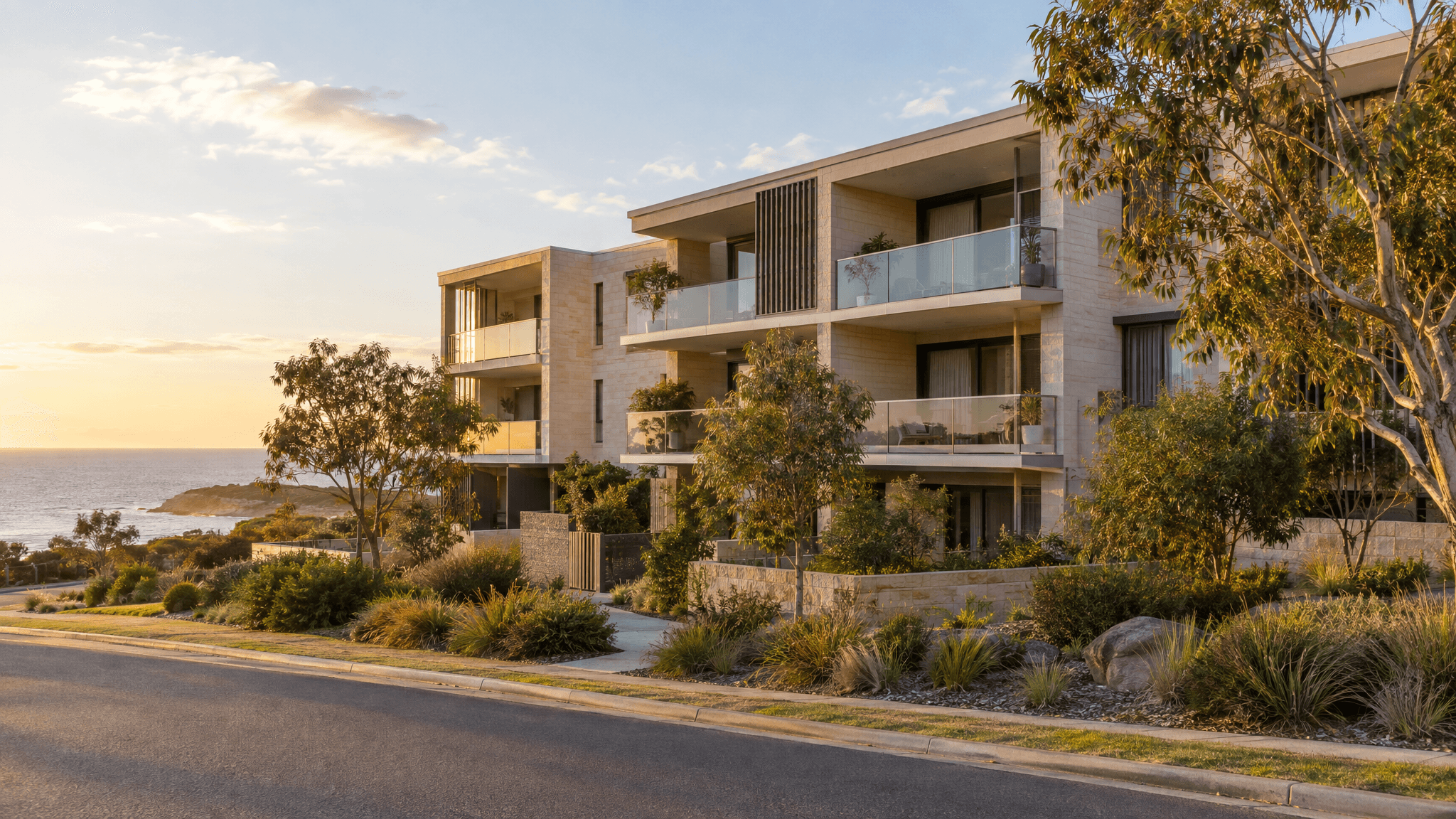
A $23.5 million social housing development in North Coogee has been completed about eight months faster than a comparable conventional build, according to a Saturday announcement from federal MP Josh Wilson and the Western Australian Government.
The project contains 38 apartments: two studios, 12 one-bedroom homes and 24 two-bedroom homes. Tenants are expected to begin moving in later in 2026, with the building to be managed by a community housing provider.
Its significance extends beyond the number of homes delivered. The development provides a completed example of governments and builders using offsite manufacturing to shorten construction, rather than simply announcing another future pipeline.
How the construction program was shortened
The apartments were completed in 14 months by PARC Developments and Tyrone Group, both based in Western Australia.
While conventional site preparation and construction were underway in North Coogee, bathroom pods and masonry wall panels were manufactured elsewhere. The finished components were then transported to the site for installation.
This allowed parts of the project that would ordinarily occur one after another to proceed at the same time. The government said the approach also reduced disruption around the construction site.
Tyrone Group manufactured the wall panels at its Neerabup facility. When the project was announced in July 2025, it was described as the first Australian use of commercial prefabricated masonry in a residential development of this kind.
The WA Department of Communities acquired the completed dwellings through an off-the-plan contract. Funding came through the Australian Government’s Social Housing Accelerator Payment program, under which Western Australia received $209.2 million for new homes and refurbishment work.
What the result does and does not prove
The eight-month time saving is important because lengthy building programs expose housing projects to changing material prices, labour shortages, finance costs and contractor risks. Finishing sooner can also bring homes into use earlier when social housing waiting lists are under pressure.
However, the announcement did not provide a like-for-like cost comparison with a traditional apartment build. It therefore does not establish that prefabrication will always produce a cheaper home, even though the shorter schedule may reduce some project costs and risks.
Not every site or design will suit the same system. Projects need to be planned around repeatable components, transport requirements and early design decisions. Changes can become difficult once factory production has started.
The North Coogee result nevertheless shows what is possible when the procurement method, building design and manufacturing process are coordinated from the beginning. It may be particularly relevant to social, affordable and key-worker housing programs where governments or community providers require multiple similar dwellings.
Why location still matters
The homes are near Fremantle, public transport, shops and community services. That matters because adding housing quickly is only part of the task: residents also need access to employment, education, health care and daily necessities.
The project adds a relatively modest number of dwellings to WA’s overall housing stock. Its larger value may be as a delivery model that can be repeated or adapted, provided future projects are assessed on their design quality, durability, cost and long-term maintenance as well as construction speed.
What it means for you
- Renters on the social housing waitlist gain 38 additional homes, with occupancy expected later in 2026.
- Buyers should not expect this individual project to materially change private prices around North Coogee.
- Faster prefabricated construction could help governments and community providers bring larger housing programs forward.
- Construction speed should still be considered alongside build quality, whole-of-life costs and access to services.